
PA12 MJF vs Injection Moulding for Low Volumes
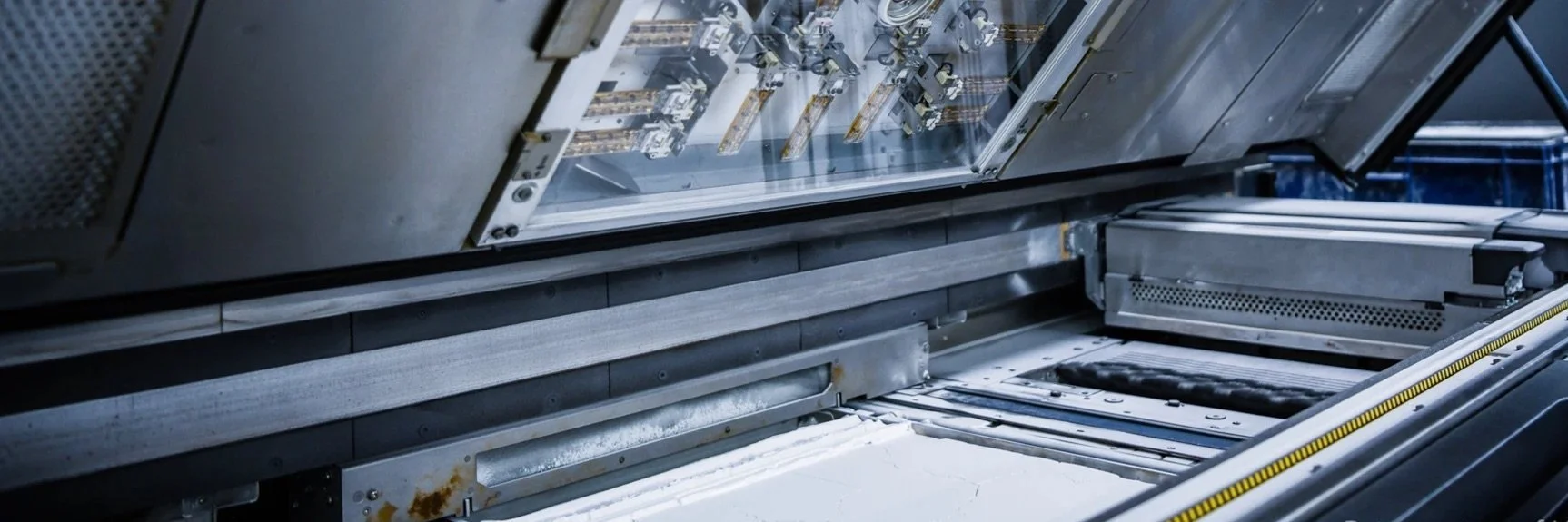
When choosing between PA12 Multi Jet Fusion (MJF) and injection moulding, the main question is not which process is better in general. It is which process fits the part, quantity, validation needs and time available.
For low volume manufacturing, MJF can remove tooling from the decision. It can also support complex geometries and short production lead times. Injection moulding remains relevant when volumes justify a mould and when a highly repeatable, established production process is required.
Start with production volume and timing
Injection moulding requires a mould. This creates an initial tooling cost and adds time before production parts are available. The cost per part can decrease as the mould is used for more units, making the process suitable for larger annual volumes.
MJF has no tooling or mould costs. This makes it practical for prototypes, pilot runs, spare parts and low volume series. Unit cost does not fall with volume in the same way as injection moulding, so the break-even point depends on part size and annual volume.
Norra’s published lead times for standard Gray Nylon PA12 made with MJF are three working days for Express, five working days for Standard and 20 working days for Planned production. Reviewed jobs depend on material, process, current workload and post-processing. The absence of tooling can also make design changes easier to manage during development.
Compare mechanical requirements, not material names
PA12 and an injection-moulded plastic should not be compared only by polymer name. The final properties depend on the material grade, process settings, part geometry, wall thickness, loading direction, temperature and validation method.
MJF parts made in Gray Nylon PA12 can be suitable for functional components, but Norra does not use general material claims as a substitute for application-specific validation. Engineers should test representative parts when strength, stiffness, fatigue life, impact resistance or dimensional stability is critical.
Stiffness is often influenced by geometry as much as by material. Ribs, bosses, wall sections and load paths should therefore be reviewed for the selected process. A design developed for injection moulding may need changes for MJF, and a design created for additive manufacturing may not be economical to mould without simplification.
Evaluate design freedom and geometry
MJF supports geometries that can be difficult or expensive to produce with moulds, including integrated features, complex external surfaces and consolidated assemblies. It also avoids the need for draft angles and parting lines that are central considerations in injection moulding. Design freedom does not mean every geometry is suitable. Internal cavities need openings large enough for powder removal, and fully enclosed voids cannot be produced in powder bed fusion.
For Norra’s standard MJF production, the usable build chamber for quoting is 380 x 284 x 380 mm. The published dimensional tolerance is plus or minus 0.3 percent of the nominal dimension, with a lower limit of plus or minus 0.2 mm. Minimum wall thickness is 0.6 mm when supported and 0.7 mm when unsupported.
These values are design guidance, not a replacement for a drawing review. Fits, moving interfaces and critical datums should be identified before production. Norra recommends 0.4 mm clearance for fixed connections and 0.7 mm for moving parts in MJF.
Consider consistency and finishing
Injection moulding can provide consistent production when the mould, machine, material and process are controlled. MJF can also produce repeatable parts, but the relevant limits and acceptance criteria should be defined for the application. A first article inspection and functional testing may be appropriate for critical components.
MJF parts have a fine matte finish straight out of the machine. Norra can also use in-house cleaning, shot peening, vapor smoothing and dyeing equipment. Vapor smoothing seals the surface and produces a finish comparable to injection moulding. Finishing can affect appearance, dimensions and function, so it should be included in the specification.
Make the process decision part-specific
Choose MJF when speed to market, low volume production, design freedom or the avoidance of tooling are important. Choose injection moulding when the expected volume supports mould investment and the part is suited to that process.
For a sound comparison, review annual volume, target cost, lead time, geometry, tolerances, mechanical loads, environment, surface requirements and validation needs. If the part is safety critical, highly loaded or exposed to demanding temperature and chemical conditions, test the actual design and production route before committing to a series.