
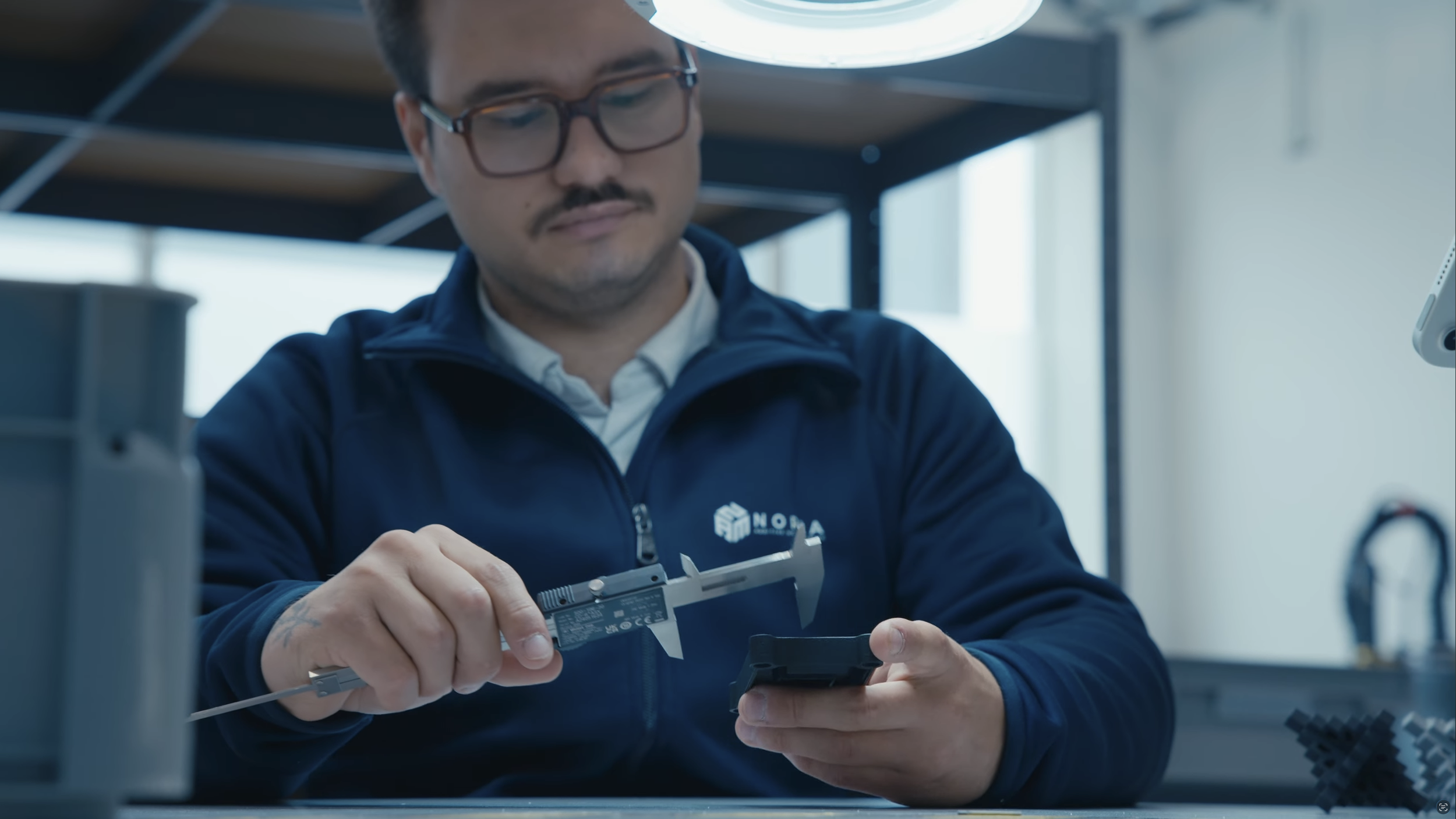
Repeatability in polymer powder bed fusion is not achieved through final inspection alone. Consistent production depends on stable manufacturing conditions, controlled equipment, standardized procedures and records that show how each batch was made.
Norra Additive Manufacturing produces polymer parts using Multi Jet Fusion, MJF, and Selective Laser Sintering, SLS. Its production equipment includes two HP Jet Fusion 5620 systems for MJF and an EOS FORMIGA P 110 for SLS. The control of repeatability starts before a part reaches the quality control station.
Maintain stable production conditions
The production environment can affect the result, particularly in a process that uses heat and polymer powder. Norra places emphasis on controlled temperature and humidity, ESD flooring and stable environmental conditions in its production facility in Hudiksvall, Sweden.
This environmental control is combined with equipment designed to monitor and manage the thermal process. The HP Jet Fusion 5620 systems use high resolution thermal cameras and precise thermal process control to support consistent MJF production. Norra also operates automated build unit switching and loader infrastructure for its MJF production.
The aim is to reduce avoidable variation between builds. Stable conditions do not remove the need for design review or inspection, but they provide a more controlled foundation for producing repeatable batches.
Reproduce documented processes
Norra’s ISO aligned quality management system supports repeatability through standardized and documented procedures. Norra is certified to ISO 9001 and ISO 14001, and its 2025 certification audits were passed with zero deviations.
For each part, Norra retains detailed production specifications. These include the print orientation and relevant process settings, so the same manufacturing setup can be reproduced for future batches. The process selected, material used and part arrangement all form part of the production setup and should be considered when repeatability is evaluated.
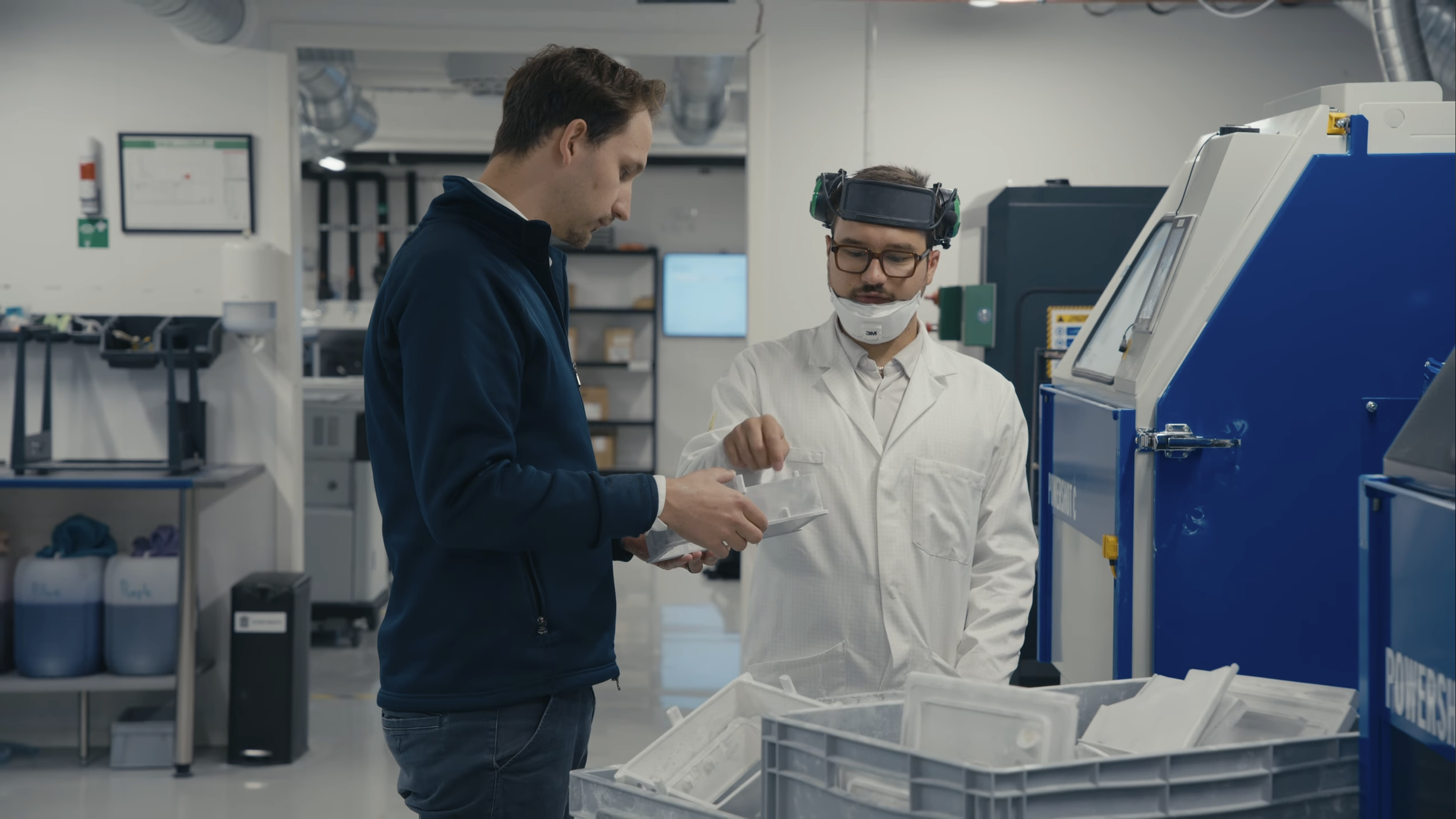
The same principle applies after printing. Norra uses in house post processing equipment including DyeMansion PowerShot C and PowerShot S systems for cleaning and shot peening, an AMT SF50 for vapor smoothing and a DyeMansion DM60 for dyeing. Standard parts have a fine matte finish straight out of the machine. Vapor smoothing seals the surface and produces a finish comparable to injection molding. Defined post processing procedures help ensure that the selected finish is applied consistently.
Use traceability to investigate variation
Full production traceability provides a record of when, where and under which conditions a batch was manufactured. Norra’s records can identify the specific printer and build, production parameters and relevant environmental conditions such as temperature and humidity.
If a deviation is found, these records support an investigation into potential causes. They also help identify other parts or batches that may be affected and support corrective actions to prevent the same issue from recurring. This is different from relying only on a final measurement, which can show that a part is outside a requirement but may not explain why.
Verify parts before release
Norra’s dedicated quality control station provides an additional verification step before parts are released to the customer. Inspection can help detect dimensional, visual or other specified deviations that remain after the controlled production process.
Norra’s documented dimensional tolerance for MJF is plus or minus 0.3 percent of the nominal dimension, with a lower limit of plus or minus 0.2 mm. For SLS, the tolerance is plus or minus 0.3 percent, with a lower limit of plus or minus 0.3 mm. These figures are starting points for planning. Critical parts may require defined datums, inspection dimensions and acceptance criteria on the drawing.
Repeatability also depends on suitable geometry. MJF and SLS have different wall thickness, hole, pin and clearance recommendations. Fully enclosed voids cannot be produced in powder bed fusion because powder must be removed through suitable openings. Very high annual volumes may also favour injection molding, since additive manufacturing has no tooling or mould costs, but its unit cost does not fall with volume in the same way.
Norra’s approach is therefore based on three principles: maintain stable manufacturing conditions, reproduce validated processes across batches, and use traceability and quality inspection to identify and reduce variation. Buyers should review the application, critical requirements and expected volumes before selecting MJF or SLS, then confirm how those requirements will be controlled throughout production.